Desktop & hardwareAmateur radio software
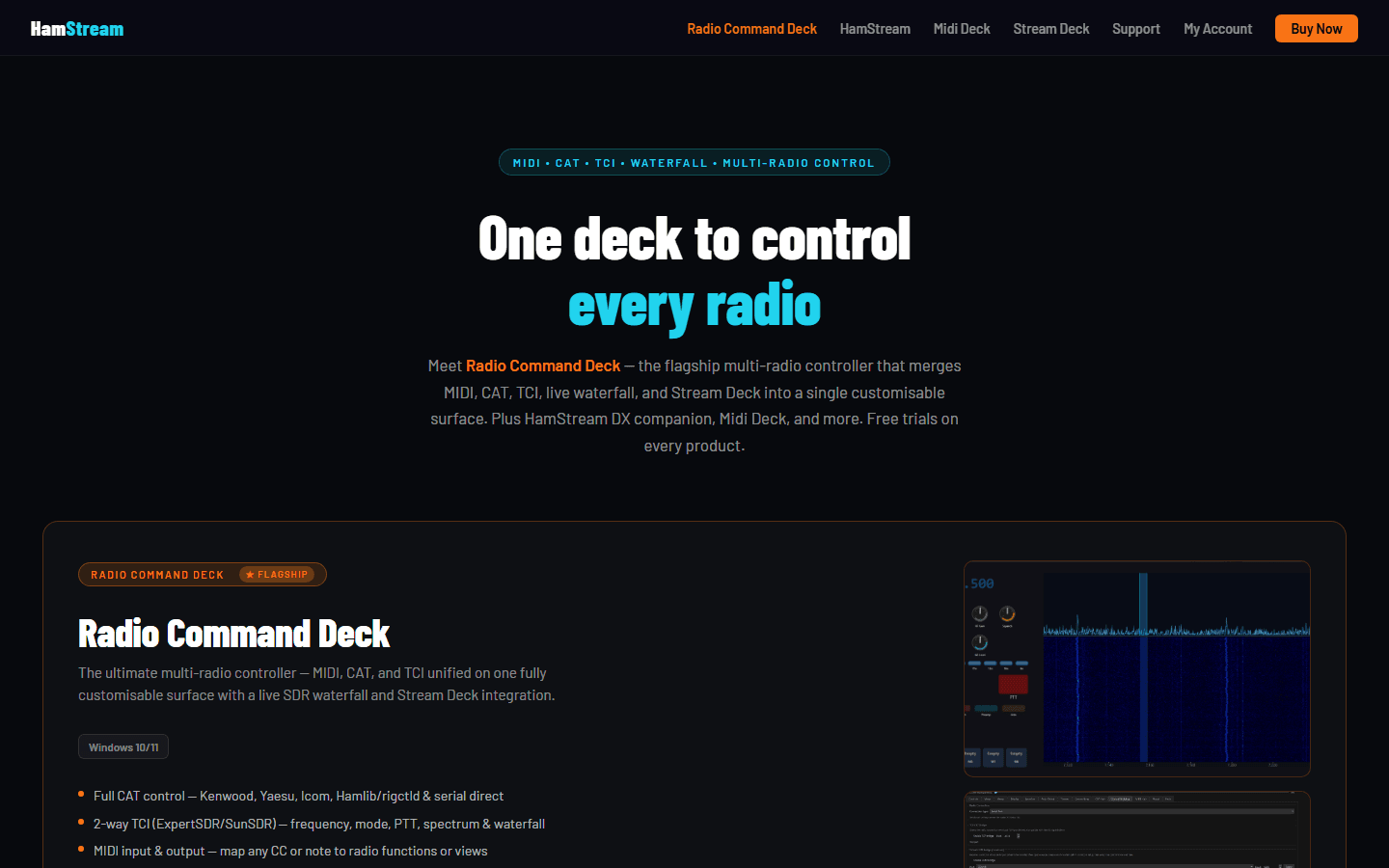
HamStream
A commercial desktop application for amateur radio operators, with a licensing system, release channels and a marketing site that sells and delivers it.
Case study hamstream.co.uk

Desktop & hardware
A native Linux client for a high-end software-defined radio whose own manufacturer ships Windows only — full waterfall, multiple receivers, real hardware protocol.
The brief
A serious piece of radio hardware was sold with client software for one operating system. Operators who run Linux either kept a Windows machine alive for it or did without. The brief was a native client that speaks the radio’s own protocol properly, so the hardware works on the desktop its owner actually uses.
The challenge
The constraints that shaped every decision after them.
What we built
The decisions that mattered, and why we made them.
Discovery, command, status and streaming are implemented against the hardware’s published protocol version, so the client is a first-class citizen on the network rather than a wrapper around someone else’s.
Spectrum and waterfall rendering is built for the data rate from the start, so wide bandwidth and a long waterfall history stay smooth on ordinary desktop hardware.
The layout, controls and terminology follow what operators already know, so moving across is a change of operating system rather than a change of habit.
C++20 and Qt 6 compiled for Linux — no compatibility layer, no virtual machine, and no Windows licence in the shack.
The outcome
Built with
More work
A commercial desktop application for amateur radio operators, with a licensing system, release channels and a marketing site that sells and delivers it.
A native software-defined radio client speaking a hardware UDP protocol directly, with multiple receivers and a touch-first interface.

A desktop image-processing tool that converts raster artwork into clean, gradient-aware vector output through a multi-stage pipeline.
Every project on this site started with a short email describing a problem. Tell us yours and we will come back with scope, cost and timescale.